Posts

Long Range Cloud Escaping

This post covers a very important subject that I suggest that all who visit the totality path think about: what would you do if the forecast calls for cloudy skies at eclipse time in the area that you're wanting to view it, and significantly clearer skies somewhere else? I will be posting some links later that are useful for reviewing weather forecasts and updates. It helps you learn how to take a deeper dive and look at the various weather models. Note that, just because the forecast calls for clouds doesn't mean that you should necessarily leave and drive to clearer skies. Certain types of clouds may dissipate, or going to clearer skies may be too far.  Also, the websites I will feature list cloud coverage in percentage. 50% cloud cover could mean that half the sky is clear, and the other half overcast- or it could mean that the clouds are scattered in all directions and overhead, but the total percentage of sky coverage is 50% (meaning: large patches of blue in between). Mor...
An Eclipse simulation program

On my solar eclipse links post at https://eclipse482024.blogspot.com/2023/08/eclipse-2024-links.html , I included a link to eclipse chaser Dan McGlaun’s site at https://eclipse2024.org/   There are a lot of great resources on this page, including a section that shows the times for the eclipse for many cities and towns in and outside of the path. There are also resources for events happening in various cities and towns (but it may not list everything) Another very good feature of the site is the eclipse simulator. Here is the direct link for the 2024 eclipse:  https://eclipse2024.org/eclipse_cities/statemap.php You can zoom in on the map and click on a location. There is also a search feature. But if you choose the name of a town, it’s going to show you the simulation from the center of town.  Once you launch the eclipse simulator, here are some useful tips:  This does work better on a computer, but it still can be done on the phone. There is an instructions link; cli...

Observing near the edge!

The posts that I’ve made about what happens during the eclipse assume that you are fairly deep within the path, and get at least a couple of minutes of totality.  What about the people who live within the path, but close to the edge? Or what if you planned to be fairly deep within the path, but clouds in that area forced you to be at an area close to the edge of the path? This post is designed to help you make the most of being near the edge of the path of totality, if by choice or if other factors made you end up there. I refer you to this map:  http://xjubier.free.fr/tse2024map   Remember when you click on the map and look at the circumstances, you want to pay attention to the “lunar limb corrected” duration of totality. Being close to the edge of the totality path does resort in a shorter totality, but you get an extended duration of certain features.  Baily's Beads The Baily’s Beads referred to in my checklist post last for a few seconds when you are deep into th...

Baily’s Beads! Diamond Ring!

As I mentioned in my solar eclipse checklist post (See it a few posts back), the sun is a thin crescent as it approaches totality. A few seconds before totality, mountains on the edge of the moon break up the crescent into a string of beads. The beads themselves are sunlight shining through valleys on the moon, and the spaces between the beads are the mountains. These are called Baily’s Beads. British astronomer Francis Baily noticed them at an annular (ring of sunlight) eclipse in 1836. He was not the first person to notice this phenomenon, but he was the first person to correctly explain what it really was, and to give a complete description of it. See more details about his report at  https://skyandtelescope.org/observing/historic-discovery-bailys-brilliant-beads/ These last one or two beads will linger for a few seconds before disappearing. At that point totality has started. It’s best to keep your eclipse glasses on all the way through the Baily’s Beads leading into totality (...

Another inspirational video: For kids! (Also, eye safety)

Moving forward, the posts on this blog will primarily deal with tips about this eclipse: what to look for, how to deal with the weather and so on. I came across this video and wondered to share it for additional inspiration. I’m sharing it specifically because there are children in the video. This family observed the total solar eclipse in Nebraska in 2017.  Please watch the video here: https://shorturl.at/mrEX3 The main thing I’m wanting everyone to focus on is the reactions. Notice the comments of fascination and wonder as the sky is getting rapidly darker.  Then notice the burst of excitement from all the children (and the adults!) when everyone takes their glasses off and sees the totally eclipsed sun- with the glorious corona- for the first time. The excitement remains throughout the rest of totality.  I’d like to make special note of a couple of brief moments in the video. At 1:51, the young girl in the royal blue shirt raises her arms and says “The total eclipse! Y...

The Total Solar Eclipse Checklist: What to look for!

The topic of this post is a checklist of what to look for if you are experiencing the eclipse. It’s primarily aimed at those who are in the path of totality, but some of this information can be used by people who will be experiencing a partial eclipse. I refer you to my earlier descriptive post on what happens during a total solar eclipse:  https://eclipse482024.blogspot.com/2022/04/an-incredible-experience-is-coming.html Also, of course, this assumes you know the eye safety rules. Before the eclipse begins, or during ANY part of the partial, you have to protect your eyes using proper methods and materials. But totality is COMPLETELY SAFE TO LOOK AT WITHOUT PROTECTION.   Realize that these changes don't even really begin until a large portion of the sun is covered, and that they are subtle at first. Then, they are noticeable but not dramatic. It's only shortly before totality that things become really dramatic. That's one of the many incredible things about totality- it tak...

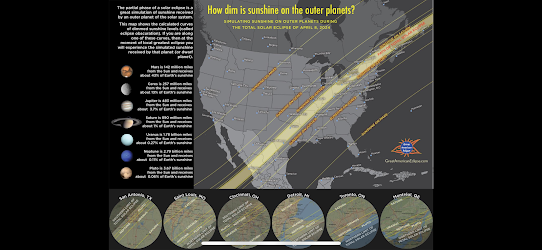
Solar Eclipses compared to sunlight on other planets

Image
So one of the most fascinating things about total solar eclipses is not just that the light level drops, it's the way it drops. You may have seen this from some of the videos posted earlier in the blog. It  is an absolutely INCREDIBLE experience to witness this! As the sunlight dims, the light level simulates the amount of sunlight that the Earth would see if it were as far away as the other planets (and other bodies) in our solar system. If you are in the path of totality, you get to see how much sunlight all the planets (and other bodies) in our solar system beyond Earth receive.  Michael Zeiler of www.greatamericaneclipse.com shared it on his Facebook page:   When the sun is about 60% covered, the sunlight is similar to what the Earth would experience if it were at the distance of Mars (~142 million miles from the Sun).  When the sun is about 96% covered, the sunlight is similar to what the Earth would experience if it were at the distance of Jupiter (~484 millio...