Posts

Solar Eclipse Paintings
Image
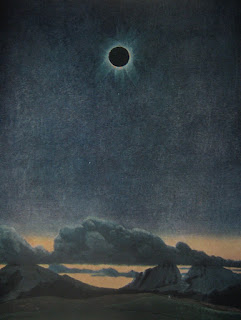
There was an art show as part of multicultural night at our daughter’s school last night. This inspired me to post this about eclipse paintings. There are lots of photographs of total solar eclipses, especially recently. In the past, a few skilled artists painted solar eclipses. Take this one, for example: source: http://palomarskies.blogspot. com/   In 1937, the artist D. Owen Stephens joined an expedition to the Andes Mountains in South America to record the total eclipse on June 8. His artistic skill was evident in his painting of the beautiful spectacle. Astronomer George Lovi once commented on the painting: "I've seen many photographs showing the sky and horizon during totality.  Yet to me not one has captured the true appearance, ambiance, and mood of the event as well as by D. Owen Stephens painting showing the June 8, 1937 total eclipse, for which he traveled to a 14,600-foot mountaintop in the Peruvian Andes.  Stephens portrayed the very delicate corona wonderful...
Another Cool Eclipse Fact: Cycles!

Solar eclipses have another amazing fact- they come in cycles. Perhaps even more amazing? How that fact was discovered. The Saros Cycle was discovered by the Baylonians  in the 7th or 8th Century B.C. Here is how they did it: https://skyandtelescope.org/astronomy-news/how-did-the-ancients-predicted-eclipses-the-saros-cycle/ When a solar eclipse happens, 18 years, 11 days, and 8 hours later, another solar eclipse with similar circumstances will occur 1/3 of the way west around the Earth. A saros series will start as a small percentage partial eclipse over the north or south polar region, gradually move north (or south) toward the equatorial regions (where the saros reaches its maximum duration (of totality or annularity (ring of sunlight)) . Then the saros continues to the opposite pole as it fades. The April 8, 2024 total solar eclipse is part of Saros #139. This page shows a bit more about the eclipses in Saros 139:  https://www.eclipsewise.com/solar/SEsaros/SEsaros139.html ...

Solar Eclipse Eye Safety

We are a bit over 2 months away from the eclipse, so I thought that this was as good a time as any to review eye safety details with you.  Here is the most important thing to remember from this post: anytime the sun is not covered at all, or partially covered (even including 99%!) you MUST use proper methods AND proper materials to PROTECT your eyes. However, if you are in this path of totality: http://xjubier.free.fr/tse2024map   then DURING THE TOTAL PHASE ONLY, WHEN THE SUN IS COMPLETELY BLOCKED, it is COMPLETELY SAFE to look at the sun directly without any protection. If you try to use eye safety protection during totality, you'll miss the best part! When the sun returns, you MUST go back to the proper eye safety methods and materials.  So, how do you keep your eyes safe before and after the eclipse, as well as during the partial eclipse (or partial phases before and after totality)? Well, I'll just let the American Astronomical Society tell you: https://eclipse.aas.o...

I have to work! The kids are in school! Or: I'm just not interested (In the path of totality)

This post is mainly for people in the path of totality who: May have to work on eclipse day  Managers/supervisors who a re concerned about losing production time/money Those who have kids in school, and schools are in session that day Principals/Administrators who are concerned about certain students looking at the eclipse (directly during the partial phases) Are not that interested (if you're in the totality path and not interested, please read some of my other posts, especially the ones titled "An inspiring....") I would like to convince as many people in the path of totality as possible to take the whole day off from work - and their kids out of school- to experience the eclipse together. But I know it's not practical for everyone.  In my opinion, it's about understanding the timing. The eclipse lasts for about 3 hours, from beginning to end. Not all of that is necessary. After totality, the eclipse is anti-climactic (although the first few moments are impressi...

Totality: it's getting dark!

Image
This post covers the darkness of a total solar eclipse, and why it's so special. I've read some comments online (and heard some from people I know) that state things like "I can watch it get dark at night!" At a total solar eclipse, it's not just that it gets dark. It's the WAY it gets dark. People are often surprised how much the sun is covered before any change in light is noticed. At that point, the change is so subtle that you wonder if your eyes are fooling you. The sun is significantly covered when the changes in light are noticeable.  But even when 99% of the sun is covered, it's not very dark. The glare is basically gone by this point - you don't have to squint when looking at the landscape- but the brightness is still there. In that final 60 seconds or so, the light level drops VERY rapidly. There is nothing else in nature like it! The very best way to convey this is through video. Please take a look at my video of the 2017 eclipse:  https://w...

A VERY inspiring eclipse story

This. This right here. Please take 9 minutes out of your day (not necessarily today, but someday soon) to watch this inspiring story: https://shorturl.at/itKOY It features a woman named Liz who had stage 4 cancer and a 5 percent chance of living. Her daughter “imposed” a trip on her to see a total solar eclipse- as a “last hurrah” of her life. Liz wasn’t interested- she preferred “champagne and chocolates.” Watch the video to see the amazing result. Notice that neither one of them were one of the “geeky” eclipse chasers. THIS is the impact of a total solar eclipse. THIS is why I want people to put seeing a total solar eclipse someday on their bucket list, even if they can’t make it to this one in April. THIS is why I want you to take a look at this map:  http://xjubier.free.fr/tse2024map  , try your best to go between the red lines, and spread the word to your friends and family about it. Not everyone who witnesses a total solar eclipse has this level of reaction.  But th...

Choosing a specific observing location

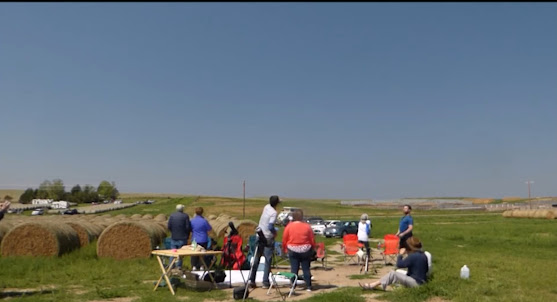
Today, I'll be covering the topic of choosing an observing location within the path of totality. You don't necessarily have to plan well in advance which exact location from which you'll watch the eclipse, but it might be a good idea to consider which factors are most important to you. Here are some things that you may want to think about:   Most Important   1.   (obviously!)   The observing location must be within the zone of totality. If you're outside the main shadow path (even by a short distance!) you won't see the sun completely blocked, and you'll wonder what the excitement was about. See my previous blog posts about this! As a reminder, the totality path is in between the red lines on this map, courtesy of Xavier Jubier:  http://xjubier.free.fr/tse2024map   2. (obviously!)  Make sure the location that you pick does not have something (hills, trees, tall buildings) that may block the Sun at eclipse time.  The Sun will be about 60...